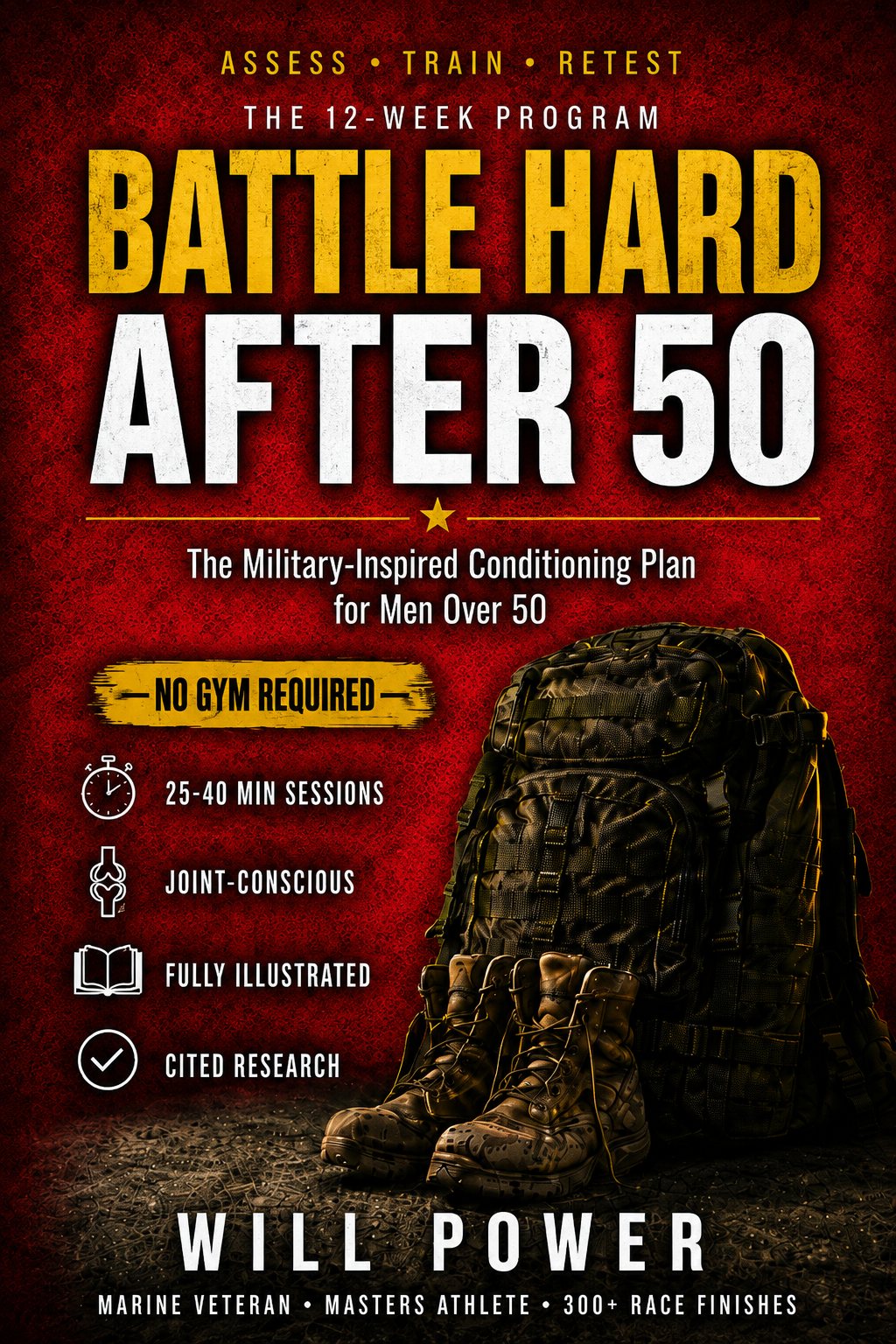
BATTLE HARD AFTER 50
Athlete Series · $9.99
A twelve-week, no-gym-required strength and conditioning protocol for men over 50, built on a five-domain self-assessment — strength, power, engine, carry and grip, and mobility — instead of one overall fitness score.
GET THE BOOK ON AMAZON →WHAT YOU'LL LEARN
- ✓The five-domain assessment: strength, power, engine, carry and grip, and mobility
- ✓What changes after 50, what doesn't, and why the five domains don't decline together
- ✓Bodyweight strength across push, pull, squat and hinge, with a five-column progression
- ✓Power training, loaded carries, and a rucking progression that starts below military loads
- ✓Building the engine with weekly aerobic minutes, and a mobility warm-up sequence
- ✓A recovery decision framework, food-first fueling, and a short supplement list
- ✓The 12-week protocol in four phases, a 15-minute emergency session, and retesting
WHAT'S INSIDEShow
- Battle Hard After 50
- The Battle Hard Assessment
- What Changes After 50 — and What Doesn't
- Strength: Move Your Own Body First
- Power: Don't Let Fast Become Something You Used to Be
- Carry Something Heavy
- Build the Engine
- Ruck
- Mobility Is Access
- Recovery Is Part of the Program
- Fuel the Mission
- The Battle Hard 12-Week Protocol
- Retest: Earn Your Next Standard
- Battle Hard for Life
- Appendices: Exercise Library, 12-Week Training Log, Assessment and Retest Sheets, and Load It Up Progression Table
FREE TOOL
GET YOUR PERSONALIZED PROTOCOL
Answer a few questions and get a training, nutrition, and recovery protocol built for your body, goals, and schedule.
FREE TOOL
GET A FREE RACE TRAINING PLAN
A week-by-week plan built around your race, your fitness, and the days you can train. No account required.
FREE READER DOWNLOADS
PRINTABLE WORKSHEETS
The book's worksheets as letter-size, print-ready PDFs with room to write. Free, no email required.
ALREADY READ IT?
LEAVE A REVIEW
A short, honest review helps other readers find this book more than anything else. Two sentences is plenty.
FROM THE BLOG
RECOVERY AFTER 50: REST DAYS, SLEEP AND DELOADS, THE COMPLETE GUIDE
How many rest days do you need after 50? What studies comparing older and younger athletes found, the sleep guidelines, deloads, HRV, cold water and how Battle Hard After 50 and The Hybrid Athlete Protocol handle recovery.
12 min read →
STRENGTH TRAINING AFTER 50: THE COMPLETE GUIDE FOR BEGINNERS
Strength training after 50 for beginners: the assessment, movement patterns, how heavy to lift, power, grip, bone, recovery and a 12-week plan.
13 min read →
RETEST, DON'T GUESS: TELLING A REAL GAIN FROM MEASUREMENT NOISE
Twelve weeks on, you run the same five-domain battery again. The hard part is reading the result honestly: published test-retest figures show strength measures repeat tightly while power measures repeat loosest, and grip has to move about 3.5 kg before the change can be told apart from the test's own noise.
6 min read →
WHAT CHANGES AFTER 50 — AND WHAT TRAINING STILL CONTROLS
Chapter 2 gave you five numbers. This chapter explains why they move at different speeds — power fades before strength does, recovery timelines shift without a fixed formula, and resistance training still produces real, measurable strength gains at fifty-plus.
5 min read →
THE BATTLE HARD 12-WEEK PROTOCOL: ONE SCHEDULE FOR EVERYTHING BEFORE IT
Chapter 12 of Battle Hard After 50 assembles ten chapters of testing, movement standards, and recovery rules into one twelve-week schedule. Here is how the four phases fit three sessions a week, why a domain score and a movement's starting column are not the same number, and the fallback for the weeks that do not cooperate.
5 min read →
FUEL THE MISSION: WHAT THE EVIDENCE ACTUALLY SUPPORTS FOR PROTEIN AND SUPPLEMENTS AFTER 50
Protein does more for a training program than any capsule. Here is what the randomized-trial evidence actually supports for vitamin D, K2, magnesium, omega-3, and creatine after 50 -- and where it stops.
7 min read →
RECOVERY AFTER 50: WHAT A SYSTEMATIC REVIEW FOUND, AND THE DECISION FRAMEWORK TO USE INSTEAD
A 2023 systematic scoping review of resistance-exercise recovery in adults 65 and older found too much variability across studies to support a precise, universal recovery formula. Here is what that review actually concluded, and the four-tier decision framework Chapter 10 of Battle Hard After 50 uses instead of a fixed weekly deload.
6 min read →
MOBILITY AFTER 50: WHAT THE MOVEMENT-SCREEN DATA SHOWS, AND THE TRIALS NOBODY RAN
Movement-screen scores in 97 active adults aged 52 to 83 declined with age and BMI and rose with activity level. The largest fall-prevention review ever assembled found no trials at all comparing flexibility exercise against a control. Here is what the mobility evidence covers, what it does not, and the ten-minute warm-up sequence from Chapter 9 of Battle Hard After 50.
6 min read →
HOW MUCH CARDIO AFTER 50? THE WEEKLY MINUTE TARGET, NOT THE ZONE CHART
Current U.S. guidance sets the adult aerobic target at 150 to 300 minutes of moderate activity a week. The Copenhagen City Heart Study followed 8,697 adults for 25.6 years and reported a U-shaped association with mortality. Here is what both actually say, and the two-to-three-session protocol from Chapter 7 of Battle Hard After 50.
7 min read →
CARRY SOMETHING HEAVY: THE GRIP YOUR TEST SCORE DOESN'T MEASURE
Grip is three separate qualities, and the dynamometer test measures the one Chapter 6 doesn't train. Loaded carries, the supported dead hang, and the claims the chapter deliberately refuses to make about grip strength and mortality.
8 min read →
POWER AFTER 50: THE QUALITY THAT FADES FASTER THAN STRENGTH
Chapter 5 of Battle Hard After 50 argues power deserves its own training domain, not a footnote inside strength work. Here is the cross-sectional evidence on how fast it fades, the fiber-composition study on why staying generally active does not cover it, the review that partly undercuts the case, and the full broad-jump-to-sit-to-stand progression.
7 min read →
MOVE YOUR OWN BODY FIRST: THE FOUR MOVEMENTS BEFORE THE BARBELL
Chapter 4 of Battle Hard After 50 builds four movement families — Push, Pull, Squat, Hinge — using only a floor, a wall, a chair, and your own bodyweight. Here is the five-column progression system, the performance markers that earn the next level, and the specific form breakdowns the chapter expects.
7 min read →
RUCKING AFTER 50: THE MILITARY LOAD NUMBERS, AND THE ONE EVERYBODY ADDS
Army foot-march doctrine sets a fighting load near 30 percent of bodyweight and an approach march near 45 percent. The 10-to-15-percent-per-week progression rule everyone quotes is not from that doctrine. Chapter 8 of Battle Hard After 50 separates the two, plus what a 2021 international load-carriage review adds on frequency and injury.
7 min read →
THE FIVE-DOMAIN FITNESS ASSESSMENT EVERY MAN OVER 50 SHOULD RUN
Most fitness books hand you one overall score. This one hands you five separate numbers — strength, power, engine, carry and grip, and mobility — because a fifty-plus body doesn't decline on one schedule. Here's the actual five-test assessment, and which benchmarks come from published research versus a plainly labeled house standard.
6 min read →
LISTEN
EPISODE 1
THE BATTLE HARD STANDARD
What Battle Hard actually means, why it is not a military program despite the name, and why a standard you cannot retest is not a standard at all.
EPISODE 2
THE FIVE-DOMAIN ASSESSMENT
Five tests, five numbers -- push-ups, broad jump, the Rockport walk, grip strength, and the chair sit-and-reach -- and why they should never be averaged into one score.
EPISODE 3
POWER: THE QUALITY THAT DECLINES FIRST
Why power -- how fast you can produce force -- tends to fade earlier and faster than raw strength, and what the broad-jump test reveals that a strength number alone will not.
EPISODE 4
CARRY AND GRIP: THE TEST THAT FAILS QUIETLY
Why grip strength is one of the more studied predictors in aging research, the three kinds of grip most men never think about, and how to train loaded carries without a gym.
EPISODE 5
RUCK: THE MOVEMENT EVERY MAN OVER 50 SHOULD OWN
Why rucking gets a full chapter instead of a footnote, the honest boundary between military load-carriage design and a civilian training progression, and how to start.
RELATED
SEE THE SUPPLEMENT STACK
The evidence-backed stacks referenced throughout this book and the broader WPP protocol system.
QUESTIONS READERS ASK
WHO IS THIS BOOK FOR?+
Men over 50 who want to know where they actually stand and train from there. The printed benchmark bands were built on populations up to about age 69; readers 70 and older run the same program and tests and lean on their raw scores.
DO I NEED A GYM?+
No. The core program uses your bodyweight, a wall, a step, a chair and a backpack you already own, plus a resistance band and a doorway pull-up bar for a few pulling movements. Optional ways to add load are built in.
WHERE DO I START?+
With the assessment chapter: five tests that give you separate numbers for strength, power, engine, carry and grip, and mobility. You train each domain at its own level instead of working from one overall score.
IS IT A TRAINING PLAN OR GENERAL ADVICE?+
A plan. The 12-week protocol runs in four phases, includes a 15-minute emergency session for weeks that fall apart, and ends with the same five tests so you can compare.
IS THIS MEDICAL ADVICE?+
No. The book is educational and is not a substitute for care from a clinician who knows your history. Talk to your physician before starting a new exercise program.
ABOUT THE AUTHOR
Will Power is the founder of Will Power Protocols, built around a simple idea: people make better decisions when they understand the science behind them. A Marine veteran and lifelong competitive athlete, he has completed more than 300 races across triathlon, road races, cross-country, track and field, Tough Mudder, CrossFit, and Orangetheory competition, is a four-time Ironman finisher, and qualified for USA Triathlon Nationals as a Clydesdale athlete. He writes each book as a research project: claims sourced to the primary literature, cited in place, and where the evidence is thin or mixed, the book says so. He is not a physician, dietitian, researcher, healthcare provider, lawyer, or financial advisor — these books are educational, not individualized medical, financial, or legal advice. Battle Hard.
MORE ABOUT WILL POWER →FREE GUIDE
10 WILL POWER RULES AFTER 50
Sleep, protein, strength, cardio, daily movement, and more: what the research measured, in a five-page PDF. Free. Enter your email and it opens right away.
You'll also get the occasional newsletter. No spam. Unsubscribe anytime.
Medical disclaimer. This book and its companion content are for educational purposes only and are not medical advice. Consult your physician before making changes to your supplement, training, or nutrition regimen.