RECOVERY AND SLEEP AFTER 50 · FREE TOOL
SLEEP CONSISTENCY CALCULATOR
Enter a week of bedtimes and wake times. See your average time in bed, how many nights fell under 7 hours, and how much your schedule moved, next to the published sleep guidelines.
Enter at least two nights. A week of normal life, weekends included, shows the most. Nothing you type leaves your browser.
KEEP READING
Rest days, sleep and deloads in one place: Recovery After 50, the complete guide. What the cohort studies measured on sleep timing: Sleep Regularity After 50. And what alcohol does to sleep after 50.
SOURCES
- Watson NF, Badr MS, Belenky G, et al. Recommended Amount of Sleep for a Healthy Adult: A Joint Consensus Statement of the American Academy of Sleep Medicine and Sleep Research Society. J Clin Sleep Med. 2015;11(6):591-2. PMID 25979105
- Hirshkowitz M, Whiton K, Albert SM, et al. National Sleep Foundation's sleep time duration recommendations: methodology and results summary. Sleep Health. 2015;1(1):40-43. PMID 29073412
- Windred DP, Burns AC, Lane JM, et al. Sleep regularity is a stronger predictor of mortality risk than sleep duration: a prospective cohort study. Sleep. 2024;47(1):zsad253. PMID 37738616
SLEEP AND RECOVERY IN THE BOOKS

WIN THE LONG WAR
The full-spectrum longevity framework for men over 50. Sleep, inflammation, metabolic health, and the supplement stack that actually moves the needle.
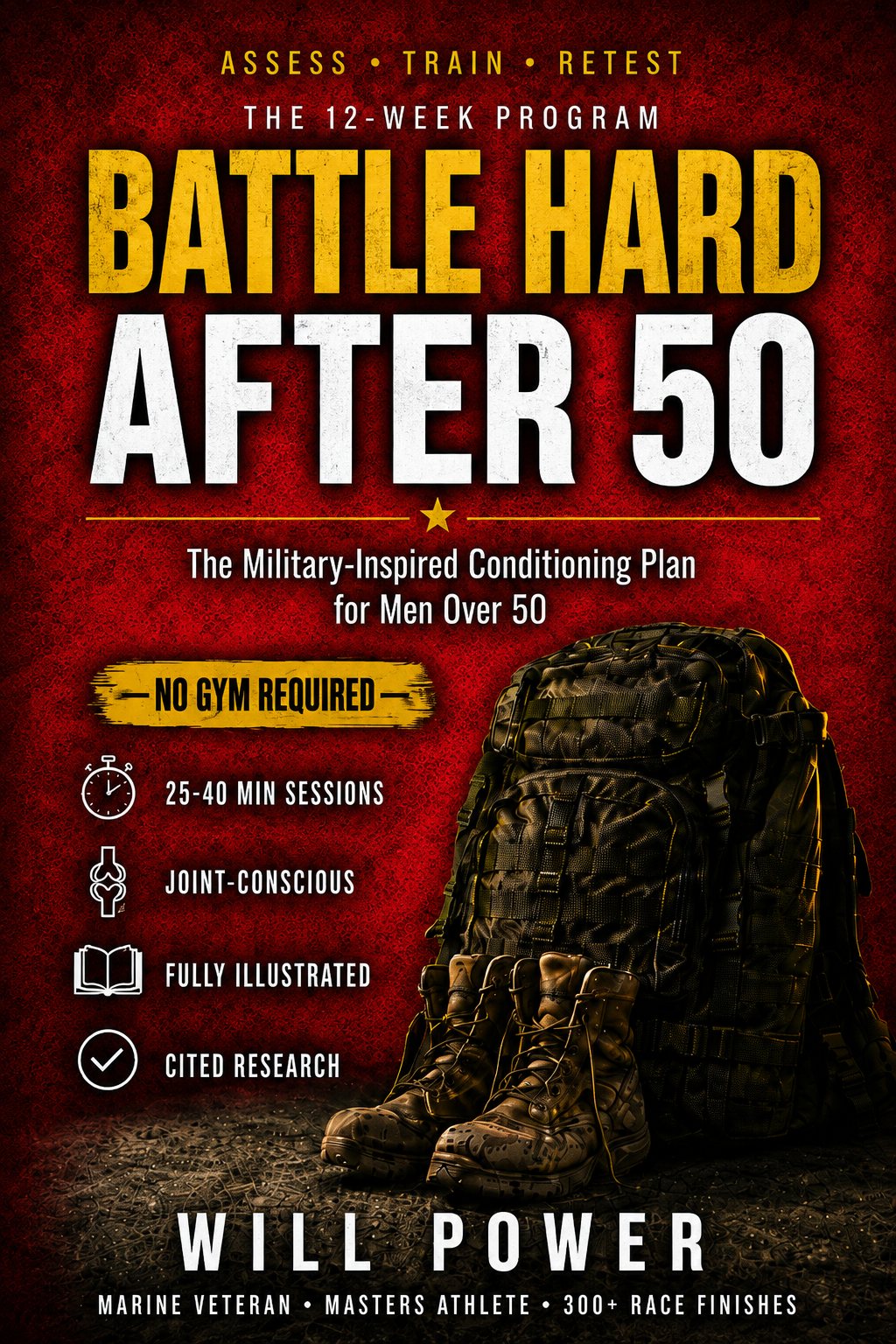
BATTLE HARD AFTER 50
A twelve-week, no-gym-required strength and conditioning protocol for men over 50, built on a five-domain self-assessment — strength, power, engine, carry and grip, and mobility — instead of one overall fitness score.
QUESTIONS
HOW MUCH SLEEP DO ADULTS OVER 50 NEED?+
The American Academy of Sleep Medicine and the Sleep Research Society (2015) recommend 7 or more hours per night on a regular basis for adults 18 to 60. The National Sleep Foundation's 2015 panel recommended 7 to 9 hours for adults 26 to 64 and 7 to 8 hours for adults 65 and over. Both are for healthy adults without a sleep disorder.
WHY DOES A REGULAR SLEEP SCHEDULE MATTER?+
In a UK Biobank study of 60,977 adults whose sleep was measured with wrist devices (Windred 2024), people with more regular sleep timing had lower death rates over the follow-up than people with the least regular sleep. Those are observational findings: they show an association, not that changing your schedule changes your risk. Our post on sleep regularity covers what those studies measured.
IS TIME IN BED THE SAME AS SLEEP?+
No. This calculator uses the times you went to bed and got up, so it measures time in bed. Most people take some time to fall asleep and wake briefly during the night, so actual sleep is usually shorter. A wearable or a sleep diary can estimate the difference.
WHAT COUNTS AS A BIG CHANGE IN BEDTIME?+
The guidelines don't set a number for how much bedtimes should vary. The calculator shows your own spread so you can compare one week with another.
I SLEEP BADLY MOST NIGHTS. WHAT SHOULD I DO?+
This tool shows your schedule, not a diagnosis. If you regularly sleep poorly, snore loudly, stop breathing at night or feel sleepy during the day, talk with your physician. The AASM statement also advises people worried they sleep too little or too much to see a healthcare provider.
FREE GUIDE
RECOVERY AFTER 50 DAILY CHECK
A short morning recovery check and the back-off steps from Battle Hard After 50 and The Hybrid Athlete Protocol, plus a four-week sleep and recovery log. Free PDF. Enter your email and it opens right away.
You'll also get the occasional newsletter. No spam. Unsubscribe anytime.
For education only. This is not medical advice and not a diagnosis. Talk with your physician about your sleep, especially if you snore loudly, stop breathing at night or feel sleepy during the day.