STRENGTH TRAINING AFTER 50
Building and keeping strength after 50. Lifting loads, power and jumping, grip, carries and rucking, bone density, and how to progress without getting hurt.
32 ARTICLES
BOOKS ON THIS TOPIC
ARTICLES
HEAVY OR LIGHT WEIGHTS AFTER 50: WHAT THE META-ANALYSES MEASURED
Lifters over 50 are often told to drop the weight and add reps. Pooled trials in older adults compared heavy and light resistance training. Here is where heavier loads were linked to larger gains, where load did not clearly matter, and what the research has not studied.
MORNING OR EVENING TRAINING AFTER 50: WHAT THE RESEARCH MEASURED
Four systematic reviews have compared morning versus afternoon or evening training, and they do not agree with each other. Here is what each one measured on strength, muscle size, glucose, blood pressure and sleep, how low the authors rated their own certainty, and the one finding that was consistent.
RETEST, DON'T GUESS: TELLING A REAL GAIN FROM MEASUREMENT NOISE
Twelve weeks on, you run the same five-domain battery again. The hard part is reading the result honestly: published test-retest figures show strength measures repeat tightly while power measures repeat loosest, and grip has to move about 3.5 kg before the change can be told apart from the test's own noise.
LIFT FIRST OR CARDIO FIRST? WHAT THE SESSION-ORDER RESEARCH FOUND
Lift first or cardio first? Four session-order studies, including a meta-analysis in adults 50 to 73 and a 2026 umbrella review, point in different directions depending on who was studied and what was measured. Chapter 2 of The Hybrid Athlete Protocol treats order as a lever, not a law.
STRENGTH TRAINING AND DEPRESSIVE SYMPTOMS: WHAT THE RANDOMIZED TRIALS MEASURED
Meta-analyses of randomized trials report that resistance training was associated with reduced depressive symptoms, but the authors rated confidence low to very low and found smaller effects in better-blinded trials. Here's what was measured, how the numbers differ in adults over 60, and what the evidence doesn't cover.
THE BATTLE HARD 12-WEEK PROTOCOL: ONE SCHEDULE FOR EVERYTHING BEFORE IT
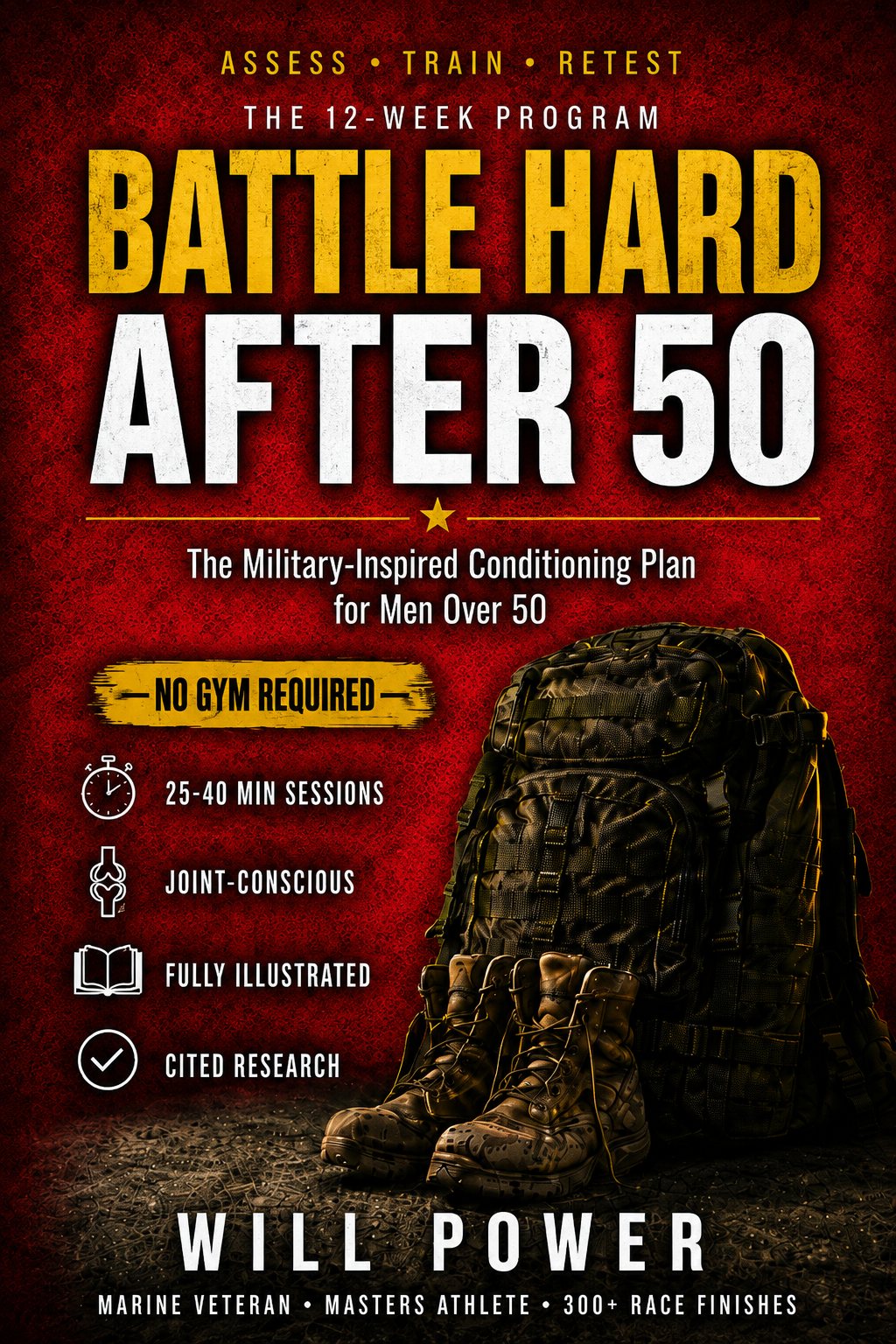
Chapter 12 of Battle Hard After 50 assembles ten chapters of testing, movement standards, and recovery rules into one twelve-week schedule. Here is how the four phases fit three sessions a week, why a domain score and a movement's starting column are not the same number, and the fallback for the weeks that do not cooperate.
WHY STRENGTH AND ENDURANCE MAY BE THE BEST TRAINING COMBINATION AFTER 50
A 2023 systematic review of 566 adults ages 50-73 found that combined strength and endurance training improved strength, power, and endurance compared with doing nothing. Its breakdown by session order points to associations, not a settled rule.
CARRY SOMETHING HEAVY: THE GRIP YOUR TEST SCORE DOESN'T MEASURE
Grip is three separate qualities, and the dynamometer test measures the one Chapter 6 doesn't train. Loaded carries, the supported dead hang, and the claims the chapter deliberately refuses to make about grip strength and mortality.
POWER AFTER 50: THE QUALITY THAT FADES FASTER THAN STRENGTH
Chapter 5 of Battle Hard After 50 argues power deserves its own training domain, not a footnote inside strength work. Here is the cross-sectional evidence on how fast it fades, the fiber-composition study on why staying generally active does not cover it, the review that partly undercuts the case, and the full broad-jump-to-sit-to-stand progression.
MOVE YOUR OWN BODY FIRST: THE FOUR MOVEMENTS BEFORE THE BARBELL
Chapter 4 of Battle Hard After 50 builds four movement families — Push, Pull, Squat, Hinge — using only a floor, a wall, a chair, and your own bodyweight. Here is the five-column progression system, the performance markers that earn the next level, and the specific form breakdowns the chapter expects.
RUCKING AFTER 50: THE MILITARY LOAD NUMBERS, AND THE ONE EVERYBODY ADDS
Army foot-march doctrine sets a fighting load near 30 percent of bodyweight and an approach march near 45 percent. The 10-to-15-percent-per-week progression rule everyone quotes is not from that doctrine. Chapter 8 of Battle Hard After 50 separates the two, plus what a 2021 international load-carriage review adds on frequency and injury.
THE FIVE-DOMAIN FITNESS ASSESSMENT EVERY MAN OVER 50 SHOULD RUN
Most fitness books hand you one overall score. This one hands you five separate numbers — strength, power, engine, carry and grip, and mobility — because a fifty-plus body doesn't decline on one schedule. Here's the actual five-test assessment, and which benchmarks come from published research versus a plainly labeled house standard.
HMB AFTER 50: FOUR EVIDENCE SYNTHESES, THREE DIFFERENT ANSWERS
HMB is marketed as the muscle-preservation supplement for people over 50. Four recent meta-analyses and umbrella reviews looked at it — and the one design that put resistance training in both arms found almost everything washed out. A study-by-study walkthrough with the actual effect sizes.
UROLITHIN A: THREE TRIALS, THREE MISSED PRIMARY ENDPOINTS
Urolithin A has been tested in randomized trials in middle-aged adults, in adults 65 to 90, and in elite distance runners. All three missed their primary endpoint and all three found something in their secondary measures. Here is what each one actually measured — and what none of them did.
I NAMED MYSELF AFTER A QUALITY I DIDN'T HAVE
Will Power is not my real name. I gave it to myself in the spring of 2007, on a charity training ride, doing arithmetic about a hundred-mile bike ride I was not sure I could finish — before I had done a single triathlon. The origin of the name this whole site is built on, from Once a Triathlete.
PROTEIN BEFORE BED: WHAT THE OVERNIGHT MUSCLE TRIALS MEASURED
Forty-eight men averaging 72 years old, four doses, tracer infusions and overnight muscle biopsies. The 40 g arm raised overnight muscle protein synthesis; the 20 g arm did not. What the pre-sleep protein research supports, and the twelve-week trial in older adults that does not exist yet.
HEAVY LIFTING WITH THIN BONES: WHAT THE LIFTMOR TRIALS MEASURED
High-intensity resistance and impact training is generally not recommended in osteopenia or osteoporosis. Two supervised eight-month trials — 101 postmenopausal women and 93 men — measured what happened when it was applied anyway. The reported bone density, function, and adverse-event numbers.
BLOOD FLOW RESTRICTION TRAINING AFTER 50: WHAT THE RESEARCH ACTUALLY SUPPORTS
Low-load blood flow restriction training produced muscle growth comparable to heavy lifting in reviews of older adults, but the strength findings are mixed. A 2025 network meta-analysis also linked one regimen to a 13.4 mmHg diastolic blood pressure rise. What the trials measured.
LIFTING WEIGHTS LOWERS BLOOD PRESSURE — THE EVIDENCE THE CARDIO-FIRST ADVICE SKIPS
Two meta-analyses of randomized trials in older adults, Henkin 2023 and Hu 2025, found systolic blood pressure reductions of roughly 6-7 mmHg and diastolic reductions of about 3 mmHg with resistance training compared with controls.
THE ROMAN WEEK: THE SEVEN-DAY SYSTEM THAT RUNS ON YOUR WORST WEEKS
The Legion's seven-day structure, rebuilt for a modern man over 50 — the polarized training research, the concurrent-training science, and the exact weekly layout that holds even on the weeks you don't feel like running it.
OMEGA-3S AND SARCOPENIA — WHAT THE EVIDENCE SHOWS
Fish oil is marketed for the heart and brain — but a growing body of research asks whether it can also help slow age-related muscle loss. The honest answer: modest, real, and no substitute for training.
WHY STRENGTH TRAINING MIGHT BE YOUR BEST METABOLIC MOVE AFTER 50
A landmark Copenhagen study shows resistance training rebuilds the exact machinery muscle uses to clear glucose from the blood — a direct, local effect, not just a downstream benefit of losing fat.
THE PHALANX BODY: WHAT SPARTAN COMBAT TRAINING ACTUALLY BUILT
The othismos demanded sustained isometric force under load, off-balance, against active resistance — a capacity barbell training alone doesn't build. Chapter 3 makes the case for loaded carries, grappling, and grip work.
WHY POWER OUTPUT DECLINES FASTER THAN STRENGTH AFTER 50 — AND HOW TO STOP IT
Endurance training develops sustained aerobic output. It does not develop power — the rate of force development that declines 3–4% per year after 50 and predicts physical independence in later life. Here is what the research shows and how Hyrox, CrossFit, and HIIT rebuild it.
GRIP STRENGTH IS THE LONGEVITY METRIC ENDURANCE ATHLETES IGNORE
The PURE study tracked 139,691 adults across 17 countries and found grip strength predicts all-cause mortality better than blood pressure. Most endurance athletes have never tested it. Here is what the data shows — and the three exercises that move the number.
EVERY TRAINING PLAN YOU'VE DOWNLOADED WAS BUILT FOR A LIGHTER ATHLETE'S JOINTS
A 10 percent weekly mileage increase is the same percentage for every athlete — but the absolute mechanical load on a 240-pound athlete's joints is substantially larger. Here's why connective tissue, not cardio fitness, sets the real pace of progression.
YOUR BODY NEEDS MORE PROTEIN AT 55 THAN IT DID AT 35 — AND IT'S NOT CLOSE
Anabolic resistance means older muscle needs a stronger stimulus to trigger the same protein synthesis response — roughly double the leucine threshold per meal. Here's the math, and the three prompts that turn it into a framework instead of a spreadsheet.
THE FIRST FIVE YEARS AFTER MENOPAUSE DECIDE YOUR BONE DENSITY — STRENGTH TRAINING IS THE INTERVENTION
Some women lose 10 to 15 percent of bone mineral density in the first five years after menopause alone — and it's clinically silent until a fracture reveals how severe the loss has become. Resistance training is one of three evidence-based interventions that can stop it.
GRIP STRENGTH PREDICTED DEATH BETTER THAN BLOOD PRESSURE IN A 142,861-PERSON STUDY
Every 5kg reduction in grip strength was associated with a 16 percent increase in all-cause mortality risk in the PURE study — a stronger association than systolic blood pressure showed in the same dataset. The farmer's carry is a longevity test you can improve weekly.
THE ROMAN LEGION WAS RUNNING POLARIZED TRAINING 2,000 YEARS BEFORE EXERCISE SCIENCE PROVED IT WORKS
A 2006 study resolved decades of argument among exercise physiologists: elite endurance athletes train 75 to 80 percent of volume at low intensity, almost none in the moderate zone most amateurs live in. The Legion's twenty-mile march at four miles an hour was already running it.
OLDER MUSCLE NEEDS ABOUT 40 GRAMS OF PROTEIN PER MEAL TO DO WHAT 20 GRAMS DOES AT 25
Anabolic resistance is real and measurable: aging blunts the muscle protein synthesis response to a given protein dose. The fix research actually supports isn't more total protein crammed into dinner — it's distribution across the day.
SARCOPENIA IS COMING FOR YOUR INDEPENDENCE — HERE'S THE PROTOCOL THAT STOPS IT
After 50 you lose 1 to 2 percent of muscle mass per year without deliberate intervention. Most of that loss isn't aging — it's inactivity. Here's the two-day-a-week protocol that reverses it.
MORE TOPICS
THE PROTOCOL NEWSLETTER
BATTLE HARD. IN YOUR INBOX.
An email when a new research breakdown or book is published. No set schedule, so you only hear from us when there is something worth reading. No fluff, no spam.
JOIN THE LIST →Free. Unsubscribe anytime.