LONGEVITY AFTER 50 · FREE TOOL
SITTING-RISING TEST SCORER
Sit down on the floor and stand back up. Count the supports you used, and see your score out of 10 next to what a 4,282-person study recorded for each score group.
HOW TO DO THE TEST
- Clear a space on a non-slip floor, barefoot or in socks with grip. Have someone nearby, and something sturdy within reach in case you lose balance.
- Standing, cross one foot in front of the other if you like, and lower yourself to sit on the floor without leaning on anything if you can.
- From sitting, stand back up, again using as little support as you can.
- Count each hand, knee or other body part you leaned on to sit down, and again to stand up. Note whether you wobbled or lost balance either way.
SITTING DOWN
Supports used (each hand, knee or other body part you leaned on to help)
Score: 5 of 5
RISING UP
Supports used (each hand, knee or other body part you leaned on to help)
Score: 5 of 5
YOUR SITTING-RISING SCORE
10 of 10
In the 2026 study, this score falls in the “10” group.
WHAT THE 2026 STUDY RECORDED
| Score group | Died of natural causes during follow-up |
|---|---|
| 10 | 3.7% |
| 8.5 to 9.5 | 7.0% |
| 8 | 11.1% |
| 4.5 to 7.5 | 20.4% |
| 0 to 4 | 42.1% |
Araújo and colleagues followed 4,282 adults aged 46 to 75 (68% men) who had a medical fitness evaluation in Brazil, for a median of 12.3 years. These are death rates for each group in that cohort, not a prediction for any one person. After adjusting for age, sex, body mass index and clinical variables, the lowest group had 3.84 times the risk of natural death of the highest group. The study shows an association; it did not test whether improving a score changes risk.
KEEP READING
Five fitness tests and what each study measured: Fitness Tests Linked to Longevity After 50. The floor test and the one-leg stand in detail: Standing on One Leg and Rising From the Floor. Check your grip too: Grip Strength by Age Calculator.
SOURCES
- Araújo CGS, de Souza E Silva CG, Myers J, et al. Sitting-rising test scores predict natural and cardiovascular causes of deaths in middle-aged and older men and women. Eur J Prev Cardiol. 2026;33(12):2170-2178. PMID 40569873
- Brito LB, Ricardo DR, Araújo DS, et al. Ability to sit and rise from the floor as a predictor of all-cause mortality. Eur J Prev Cardiol. 2014;21(7):892-8. PMID 23242910
TEST AND TRAIN

WIN THE LONG WAR
The full-spectrum longevity framework for men over 50. Sleep, inflammation, metabolic health, and the supplement stack that actually moves the needle.
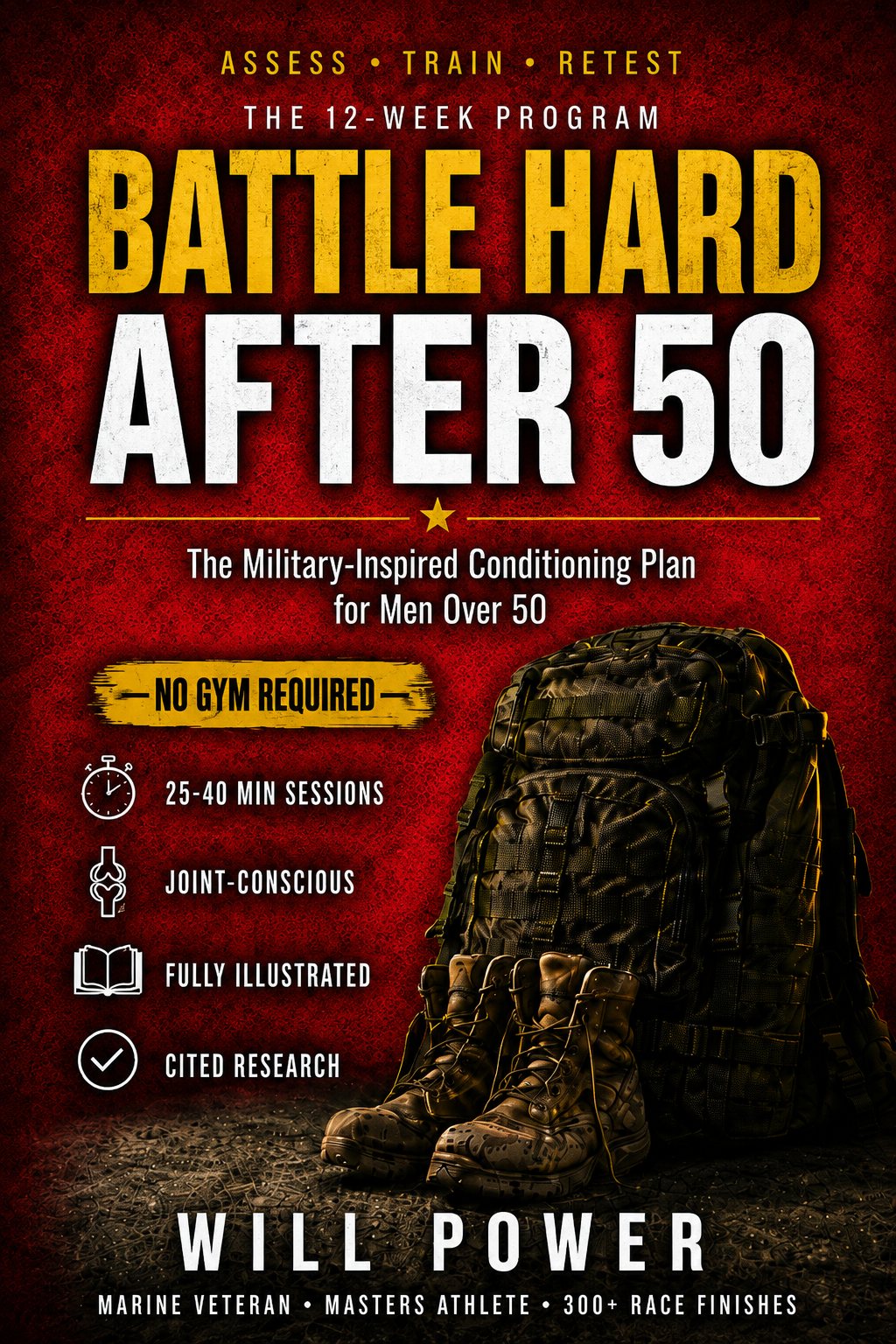
BATTLE HARD AFTER 50
A twelve-week, no-gym-required strength and conditioning protocol for men over 50, built on a five-domain self-assessment — strength, power, engine, carry and grip, and mobility — instead of one overall fitness score.
QUESTIONS
WHAT IS THE SITTING-RISING TEST?+
A floor test used by Claudio Gil Araújo's research group in Brazil. You sit down on the floor and stand back up, scoring 5 points for each half, minus one point for each support used and half a point for an unsteady movement. The total runs from 0 to 10.
WHAT DID THE STUDIES FIND?+
In a 2014 study of 2,002 adults aged 51 to 80, lower scores were associated with higher all-cause mortality over a median 6.3 years. In a 2026 study of 4,282 adults aged 46 to 75 followed for a median 12.3 years, natural-cause deaths ranged from 3.7% in people who scored 10 to 42.1% in people who scored 0 to 4. Both are observational studies from the same research group in Brazil.
DOES A LOW SCORE MEAN I WILL DIE SOONER?+
No. These are rates for groups of people in one cohort, not a forecast for an individual. The study authors present the test as one piece of fitness information that a clinician can add to an examination. It has not been tested whether raising your score changes your risk.
CAN I IMPROVE MY SCORE?+
The test depends on strength, flexibility, balance and body composition, according to the 2026 study. Training those can make sitting and rising easier, but no trial has shown that a higher score from training changes mortality. Our longevity guide covers what the studies on each fitness test measured.
IS THE TEST SAFE FOR ME?+
Skip it if you have a joint replacement, a recent injury or surgery, balance problems or a history of falls, unless your physician or physical therapist says otherwise. Always have someone nearby the first time.
FREE GUIDE
THE LONGEVITY SELF-TEST LOG
How to run five simple fitness tests at home, from the floor test to a timed walk, what the published studies measured for each, and a log to retest every three months. Free PDF. Enter your email and it opens right away.
You'll also get the occasional newsletter. No spam. Unsubscribe anytime.
For education only. This is not medical advice and not a diagnosis. Talk with your physician before trying the test if you have joint, balance or heart problems, and about your fitness and health in general.