OLDER MUSCLE NEEDS ABOUT 40 GRAMS OF PROTEIN PER MEAL TO DO WHAT 20 GRAMS DOES AT 25
By Will Power · Marine veteran, four-time Ironman, 300+ races · Last updated June 24, 2026
Not a physician, dietitian, researcher, healthcare provider, lawyer, or financial advisor. How studies are selected and cited
ANSWER
Anabolic resistance is real and measurable: aging blunts the muscle protein synthesis response to a given protein dose. The fix research actually supports isn't more total protein crammed into dinner — it's distribution across the day.
After roughly age 40, skeletal muscle becomes progressively less responsive to the anabolic signal that protein normally sends. Researchers call it anabolic resistance, and it's not a theory — it's a measurable attenuation of the muscle protein synthesis response following protein ingestion, confirmed across systematic reviews and meta-analyses.
The Actual Numbers
Older adults require roughly 40 grams of high-quality protein per meal to achieve the same muscle protein synthesis response that 20 grams produces in a younger adult. To match a younger adult's outcome, older individuals typically need both more total daily protein — in the range of 1.6 to 2.2 grams per kilogram of bodyweight — and higher leucine concentration per meal specifically, since leucine is the amino acid that triggers the synthesis signal most directly.
Why Most People Get the Math Wrong Without Realizing It
The common pattern — 8 grams at breakfast, 15 at lunch, 70 at dinner — adds up to a respectable daily total on paper while badly underfueling two of three meals. Aging muscle is less sensitive to lower protein doses than younger muscle, which means a 15-gram lunch that did nothing meaningful at 30 does even less at 60. The total matters, but the per-meal threshold matters just as much, and it's the part most people never check.
Practically: a protein anchor at every meal — eggs, fish, Greek yogurt, chicken, a whey protein isolate shake, or a legume-and-grain combination for complete amino acids — sized to roughly 30-40 grams, repeated three to four times a day, does more for muscle retention than the same total protein concentrated into one large evening meal.
The strategy that actually moves the needle isn't eating more protein in the abstract. It's making sure the protein you're already eating is distributed in doses your aging muscle can actually use.
The Bottom Line
If you're already hitting your daily protein target but it's loaded almost entirely into dinner, the fix isn't more protein — it's the same protein, redistributed across three or four meals at a real per-meal dose. That's a free change, and the evidence behind it is more consistent than almost anything else in sports nutrition.
WRITTEN BY
WILL POWER
Founder of Will Power Protocols. Marine veteran, 300+ road races & triathlons, 4x Ironman, USAT Nationals qualifier. Books on strength, longevity & performance after 50 — claims sourced. Not a physician, lawyer, or financial advisor; educational only.
KNOW SOMEONE WHO NEEDS THIS?
FREE TOOL
GET YOUR PERSONALIZED PROTOCOL
Answer a few questions and get a training, nutrition, and recovery protocol built for your body, goals, and schedule.
THE BOOK FOR THIS TOPIC
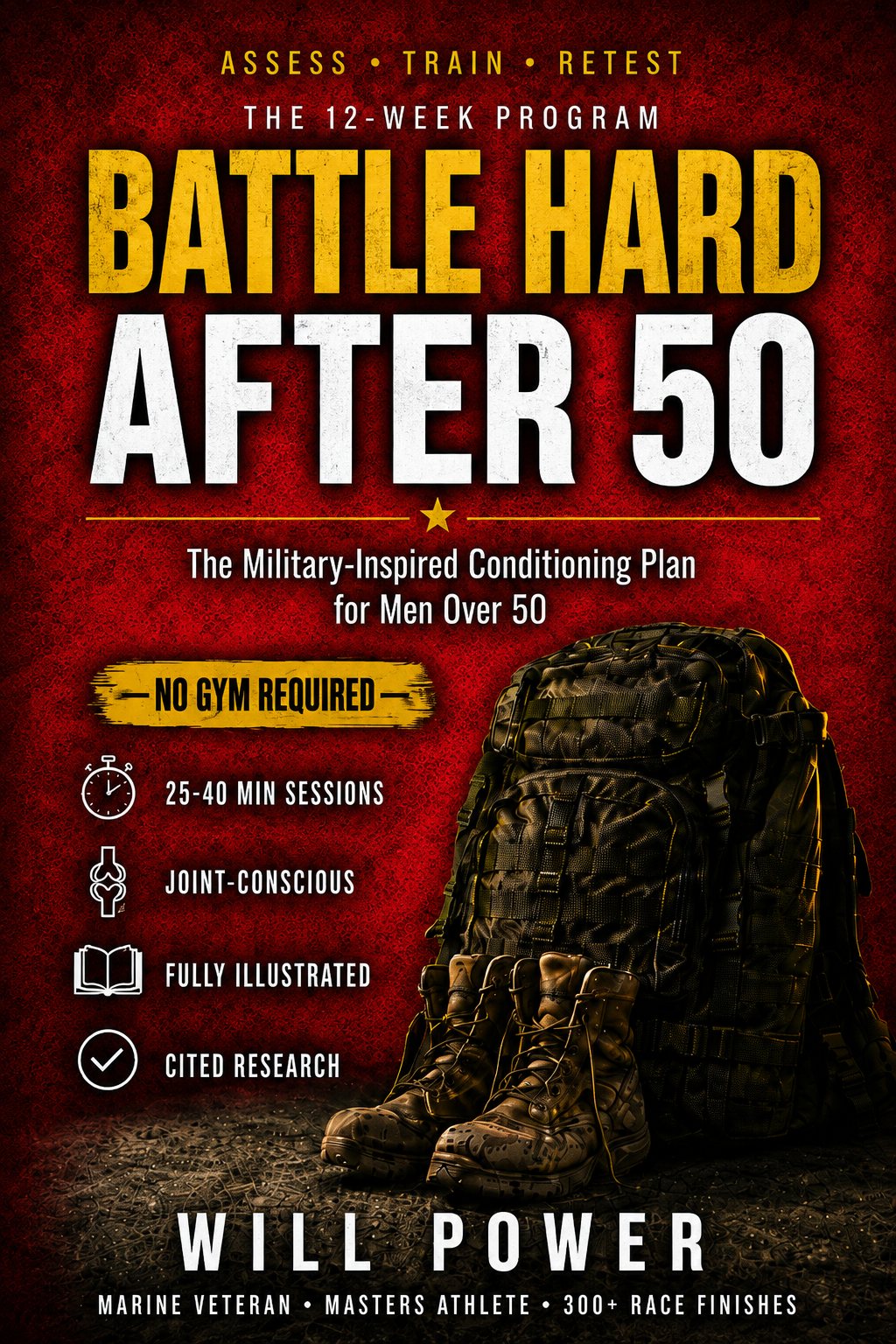
BATTLE HARD AFTER 50
A twelve-week, no-gym-required strength and conditioning protocol for men over 50, built on a five-domain self-assessment — strength, power, engine, carry and grip, and mobility — instead of one overall fitness score.
Medical disclaimer. This article is for educational purposes only and is not medical advice. These statements have not been evaluated by the Food and Drug Administration, and nothing on this site is intended to diagnose, treat, cure, or prevent any disease. I share published research as a health enthusiast and endurance athlete, not as a clinician — I do not interpret your results and I do not diagnose. Consult your physician before making changes to your supplement, training, or nutrition regimen, especially if you take prescription medication or have an existing health condition.
FREE GUIDE
PROTEIN AFTER 50 CHEAT SHEET
The protein in 29 everyday foods from the USDA database, what four published guidelines say per day, and a high-protein day from The High Protein Cookbook for Athletes Over 50. Free PDF. Enter your email and it opens right away.
You'll also get the occasional newsletter. No spam. Unsubscribe anytime.
MORE ARTICLES
PROTEIN BEFORE BED: WHAT THE OVERNIGHT MUSCLE TRIALS MEASURED
5 min read →
DOES TIME-RESTRICTED EATING COST MASTERS ATHLETES STRENGTH? WHAT THE EVIDENCE SHOWS
3 min read →
CONTINUOUS GLUCOSE MONITORS ARE TRENDING FOR HEALTHY ADULTS — HERE'S WHAT THE ACTUAL EVIDENCE SUPPORTS
6 min read →
PROTEIN FOR ATHLETES OVER 50: THE COMPLETE GUIDE
8 min read →