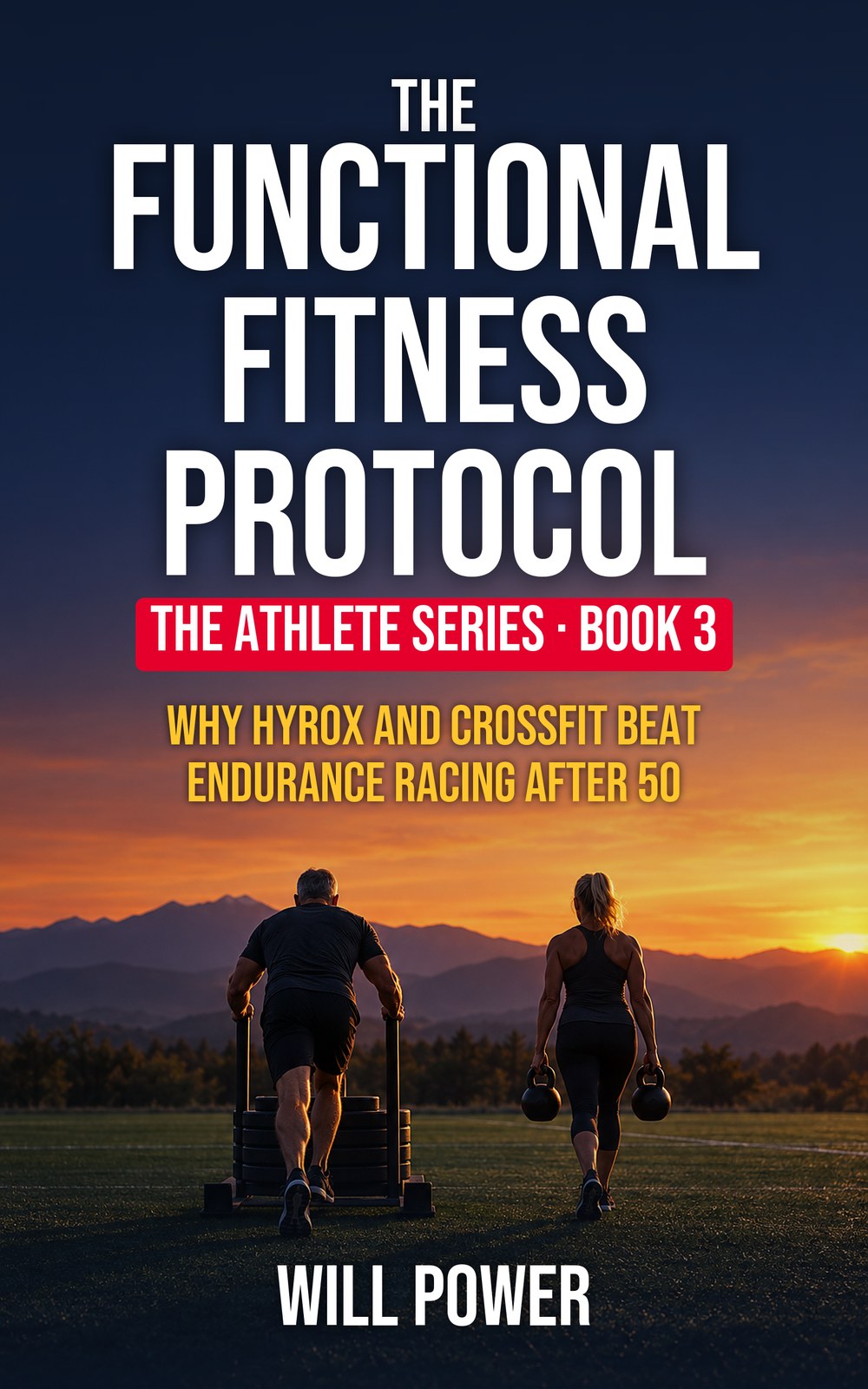
THE FUNCTIONAL FITNESS PROTOCOL
Athlete Series · $9.99
Why Hyrox and CrossFit beat endurance racing after 50. The science-backed case for redirecting your training toward grip strength, power output, and the numbers that predict the next twenty years.
GET THE BOOK ON AMAZON →WHAT YOU'LL LEARN
- ✓A time and dollar audit of what endurance racing has been costing you
- ✓What the cardiology literature says about high-volume endurance training after 50
- ✓How HYROX and CrossFit work, station by station, including your first race
- ✓Why grip strength, power output and mobility each get a chapter, with targets
- ✓What transfers from endurance training, and what you have to relearn
- ✓A four-supplement foundational stack and how to evaluate a product before buying
- ✓A 12-week transition plan, four sample weekly templates, and troubleshooting
WHAT'S INSIDEShow
- The Identity Built on Finish Lines
- The Numbers Nobody Talks About
- What Chasing More Miles Costs After 50
- The Numbers Are Already In
- How the Format Actually Works
- Grip Strength: The Number That Predicts Everything
- Power Output vs. Endurance Output
- Mobility Is the New Base Mileage
- Time Efficiency: The Hour That Replaces Ten
- What Transfers
- What You Have to Relearn
- The Foundational Stack
- The Transition Plan
- The Sample Protocols
- Troubleshooting the Transition
- Redefining the Finish Line
FREE TOOL
GET YOUR PERSONALIZED PROTOCOL
Answer a few questions and get a training, nutrition, and recovery protocol built for your body, goals, and schedule.
FREE TOOL
GET A FREE RACE TRAINING PLAN
A week-by-week plan built around your race, your fitness, and the days you can train. No account required.
AUDIOBOOK
COMING TO SPOTIFY
The full book as an audiobook, narrated by a digital voice.
ALREADY READ IT?
LEAVE A REVIEW
A short, honest review helps other readers find this book more than anything else. Two sentences is plenty.
FROM THE BLOG
HYROX DOUBLES VS SINGLES: WHAT CHANGES, AND WHAT IT MEANS AFTER 50
HYROX doubles vs singles: in Doubles, both partners run all 8 km together and split only the stations, at the same weights as singles. What that means for racers over 50, and what the research on partner training found.
6 min read →
NEW TO F45, CROSSFIT OR HYROX CLASSES? WHY THE FIRST WEEKS HURT, AND HOW TO EASE IN
New group classes like F45, CrossFit and HYROX often leave beginners very sore. What the research measured about delayed-onset soreness, the repeated bout effect, how tendons adapt more slowly than muscle, and CrossFit injury data, plus the four-week ramp-up from The Functional Fitness Protocol.
5 min read →
WHAT CHASING MORE MILES COSTS AFTER 50: WHAT THE HEART, RECOVERY AND DEPENDENCE RESEARCH MEASURED
Very high endurance volume has a research literature of its own: a Copenhagen mortality curve, atrial fibrillation data, coronary calcium scans in veteran runners, and exercise-dependence screening. Here is what each study measured, including the age detail on atrial fibrillation that runs the other way for athletes over 50.
6 min read →
THE NUMBERS NOBODY TALKS ABOUT: WHAT TWO DECADES OF ENDURANCE RACING ACTUALLY COSTS
Most endurance athletes past fifty have never actually added up what their racing years have cost — in time, money, and cumulative mechanical wear. Here's the honest ledger, and the five-minute audit to run your own.
6 min read →
WHY I SWITCHED TO CROSSFIT AND HYROX AFTER TWO DECADES OF ENDURANCE RACING
Nineteen years of triathlon, 300+ finish lines, and a cardiology literature that finally made me ask what I should be training instead of just how much. Why grip strength, power output, and mobility took over where mileage left off.
8 min read →
MOBILITY IS THE NEW BASE MILEAGE
Decades of running and cycling build a powerful aerobic engine and quietly restrict the hips, ankles, and thoracic spine. Chapter 8 makes the case for treating mobility work like base mileage.
5 min read →
THE HOUR THAT REPLACES TEN: WHY FUNCTIONAL TRAINING BEATS ENDURANCE VOLUME AFTER 50
A serious Ironman training block runs 10-20 hours a week. A competitive Hyrox or CrossFit week runs 4-6. Here's the honest, hour-by-hour comparison -- and why the gap matters more, not less, after 50.
5 min read →
GRIP STRENGTH IS THE LONGEVITY METRIC ENDURANCE ATHLETES IGNORE
The PURE study tracked 139,691 adults across 17 countries and found grip strength predicts all-cause mortality better than blood pressure. Most endurance athletes have never tested it. Here is what the data shows — and the three exercises that move the number.
8 min read →
WHY POWER OUTPUT DECLINES FASTER THAN STRENGTH AFTER 50 — AND HOW TO STOP IT
Endurance training develops sustained aerobic output, not power, the rate of force development. In studies of older adults, power declined faster than strength. Here is what the research measured and how Hyrox, CrossFit, and HIIT train it.
7 min read →
LISTEN
EPISODE 1
THE NUMBERS BEHIND 19 YEARS OF TRIATHLON
Seven to eleven thousand training hours. Fifty-five thousand to over one hundred thousand dollars in race fees and gear. A mechanical wear ledger most endurance athletes have never seen. This episode opens the honest accounting that starts the book.
EPISODE 2
GRIP STRENGTH: THE NUMBER THAT PREDICTS EVERYTHING
The PURE study tracked 140,000 adults across 17 countries and found grip strength predicts mortality better than blood pressure. This episode explains why - dead hangs, farmer carries, sled pulls, and the normative grip numbers by age.
EPISODE 3
POWER OUTPUT VS. ENDURANCE OUTPUT: WHAT ACTUALLY DECLINES
Power declines faster than strength after 50 and most endurance athletes are measuring the wrong thing. Type II fiber atrophy, HIIT to rebuild explosive output, and the standing broad jump as a proxy test you can run today.
EPISODE 4
MOBILITY IS THE NEW BASE MILEAGE
Two decades of single-plane endurance movement leaves hip flexors short, ankles restricted, and thoracic spines locked. The distinction between mobility and flexibility, why it matters more at 60 than 35, and the 10-minute daily sequence.
EPISODE 5
THE 12-WEEK TRANSITION PLAN AND FOUNDATIONAL SUPPLEMENT STACK
The three-phase redirect: four weeks of foundation and technique, four weeks of load and intensity, four weeks of race prep and simulation. Plus the four supplements the evidence actually supports for masters-age functional athletes.
EPISODE 6
REDEFINING THE FINISH LINE
The closing episode: what actually changed across this book, why the finish-line identity doesn't end but gets more accurate, and the four numbers -- grip strength, power output, mobility, time efficiency -- that now measure the next twenty years.
RELATED
SEE THE SUPPLEMENT STACK
The evidence-backed stacks referenced throughout this book and the broader WPP protocol system.
QUESTIONS READERS ASK
WHO IS THIS BOOK FOR?+
Endurance athletes over 50, especially longtime triathletes and runners, who are weighing a move toward HYROX, CrossFit or other functional fitness training.
DOES IT TELL ME TO STOP RACING?+
No. The author says plainly that it is not an anti-racing book, and one of the sample weeks is for the reader who keeps racing triathlon and adds functional training alongside it.
DO I NEED A GYM?+
The sample weeks are built around HYROX and CrossFit-style training, and the book suggests finding an affiliated gym or box and watching a class before you join. Some of its self-tests, like dead hangs and broad jumps, need very little equipment.
IS THERE A TRAINING PLAN?+
Yes. A 12-week transition plan plus four sample weeks: beginner HYROX prep, beginner CrossFit-style, a hybrid week while still racing, and a returning-from-injury week. A troubleshooting chapter covers the first 90 days.
IS THIS MEDICAL ADVICE?+
No. The book is educational and is not a substitute for care from a clinician who knows your history. Talk to your physician before changing exercise, nutrition or supplements.
ABOUT THE AUTHOR
Will Power is the founder of Will Power Protocols, built around a simple idea: people make better decisions when they understand the science behind them. A Marine veteran and lifelong competitive athlete, he has completed more than 300 races across triathlon, road races, cross-country, track and field, Tough Mudder, CrossFit, and Orangetheory competition, is a four-time Ironman finisher, and qualified for USA Triathlon Nationals as a Clydesdale athlete. He writes each book as a research project: claims sourced to the primary literature, cited in place, and where the evidence is thin or mixed, the book says so. He is not a physician, dietitian, researcher, healthcare provider, lawyer, or financial advisor — these books are educational, not individualized medical, financial, or legal advice. Battle Hard.
MORE ABOUT WILL POWER →FREE GUIDE
10 WILL POWER RULES AFTER 50
Sleep, protein, strength, cardio, daily movement, and more: what the research measured, in a five-page PDF. Free. Enter your email and it opens right away.
You'll also get the occasional newsletter. No spam. Unsubscribe anytime.
Medical disclaimer. This book and its companion content are for educational purposes only and are not medical advice. Consult your physician before making changes to your supplement, training, or nutrition regimen.