DOES TIME-RESTRICTED EATING COST MASTERS ATHLETES STRENGTH? WHAT THE EVIDENCE SHOWS
By Will Power · Marine veteran, four-time Ironman, 300+ races · Last updated July 13, 2026
Not a physician, dietitian, researcher, healthcare provider, lawyer, or financial advisor. How studies are selected and cited
ANSWER
A 2025 meta-analysis of 35 studies found intermittent fasting combined with exercise didn't hurt strength or most performance markers — but longer, more demanding fasting protocols show real costs to sleep and high-intensity output.
Time-restricted eating shows up constantly in masters-athlete circles as a body-composition tool, usually with an unstated assumption riding along: that it won't cost anything on the training side. The evidence is more specific than that assumption, and the specifics matter.
The Good News: Strength and Most Performance Markers Hold Up
A 2025 systematic review and meta-analysis in Nutrients pooled 35 studies and 1,266 participants aged 18 to 65 comparing intermittent fasting or calorie restriction combined with exercise against exercise alone. The combined approach didn't significantly affect VO2 max, bench press strength, knee extensor strength, leg press strength, countermovement jump, or gait speed — and it actually increased handgrip strength slightly compared to exercise alone. It did produce the expected reductions in body weight, BMI, fat mass, and body fat percentage, alongside a small reduction in fat-free mass.
Where It Gets More Complicated: Duration and Intensity
The picture changes with longer, more demanding fasting protocols layered onto real athletic performance. A 2024 overview of systematic reviews in the British Journal of Sports Medicine examined Ramadan fasting — a month of daily sunrise-to-sunset fasting — in athletes and physically active individuals. It found consistent associations between fasting observance and decreased sleep duration, impaired sleep quality, increased fatigue, decreased vigor, and unfavorable changes in performance during high-intensity exercise testing, even though lean mass was generally preserved.
The reviewers were careful to note the underlying evidence quality was low to critically low — this isn't a clean randomized trial in masters athletes, it's an observational pattern across a specific, unusually demanding fasting protocol. But the direction is worth taking seriously: the cost of fasting shows up disproportionately in sleep and high-intensity output, not in strength or lean mass.
Time-restricted eating and month-long dawn-to-dusk religious fasting are not the same intervention wearing different names. The daily 8-to-16-hour eating window most masters athletes actually use looks much closer to the first body of evidence than the second.
The Practical Read for a Masters Athlete
An 8-hour daily eating window, timed so training happens either inside the window or right at its edge, appears compatible with maintaining strength and most performance markers while supporting body composition goals — provided total protein and calorie intake within that window is still adequate for the training load. The risk factors worth watching are the ones the Ramadan data flags specifically: sleep duration, sleep quality, and high-intensity output. If any of those three start sliding, that's the signal to widen the window rather than push through it.
The Bottom Line
Time-restricted eating combined with training doesn't appear to cost masters athletes strength or lean mass in the way many assume it might — the handgrip data actually runs the other direction. What it can cost, in longer or more aggressive protocols, is sleep quality and high-intensity capacity. Track those two, not just the scale.
This article is educational, not medical advice. Consult a qualified professional before making changes to your nutrition protocol, particularly if you have a history of disordered eating or a medical condition affected by fasting.
WRITTEN BY
WILL POWER
Founder of Will Power Protocols. Marine veteran, 300+ road races & triathlons, 4x Ironman, USAT Nationals qualifier. Books on strength, longevity & performance after 50 — claims sourced. Not a physician, lawyer, or financial advisor; educational only.
SOURCES
- Dai ZH et al. Additional Effect of Exercise to Intermittent Fasting on Body Composition and Cardiometabolic Health in Adults With Overweight/obesity: A Systematic Review and Meta-analysis. Curr Obes Rep. 2025;14(1):54. PMID 40533648
- Kazeminasab F et al. Effects of Intermittent Fasting and Calorie Restriction on Exercise Performance: A Systematic Review and Meta-Analysis. Nutrients. 2025;17(12):1992. PMID 40573103
- Trabelsi K et al. Ramadan intermittent fasting and its association with health-related indices and exercise test performance in athletes and physically active individuals: an overview of systematic reviews. Br J Sports Med. 2024;58(3):136-143. PMID 37923379
KNOW SOMEONE WHO NEEDS THIS?
FREE TOOL
GET YOUR PERSONALIZED PROTOCOL
Answer a few questions and get a training, nutrition, and recovery protocol built for your body, goals, and schedule.
THE BOOK FOR THIS TOPIC
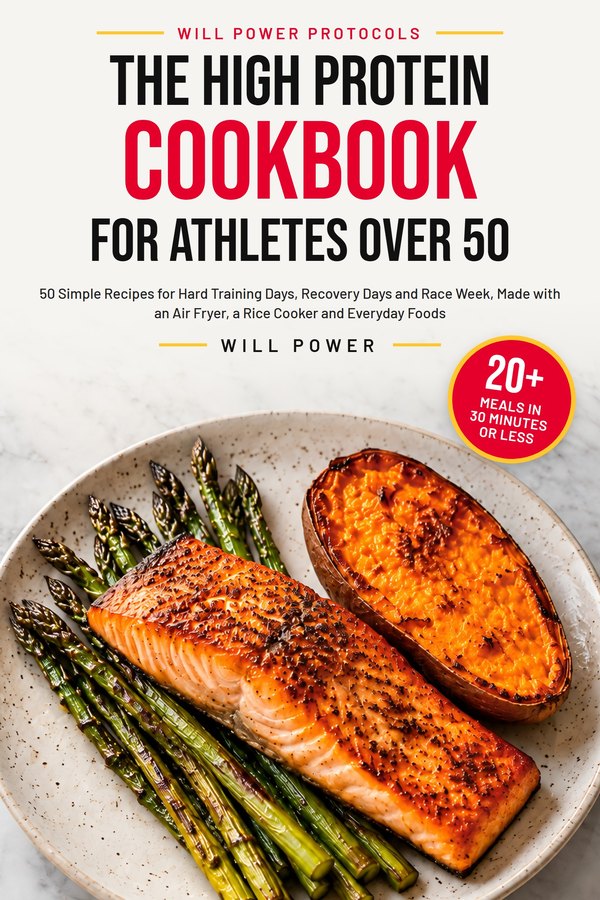
THE HIGH PROTEIN COOKBOOK FOR ATHLETES OVER 50
50 recipes I cook around hard training days, recovery days, rest days and race week. Many go in the air fryer or the rice cooker, more than 20 are ready in 30 minutes or less, and every recipe has at least 25 grams of protein per serving, a full-color photo, and nutrition estimated from USDA FoodData Central.
Medical disclaimer. This article is for educational purposes only and is not medical advice. These statements have not been evaluated by the Food and Drug Administration, and nothing on this site is intended to diagnose, treat, cure, or prevent any disease. I share published research as a health enthusiast and endurance athlete, not as a clinician — I do not interpret your results and I do not diagnose. Consult your physician before making changes to your supplement, training, or nutrition regimen, especially if you take prescription medication or have an existing health condition.
FREE GUIDE
PROTEIN AFTER 50 CHEAT SHEET
The protein in 29 everyday foods from the USDA database, what four published guidelines say per day, and a high-protein day from The High Protein Cookbook for Athletes Over 50. Free PDF. Enter your email and it opens right away.
You'll also get the occasional newsletter. No spam. Unsubscribe anytime.
MORE ARTICLES
PROTEIN BEFORE BED: WHAT THE OVERNIGHT MUSCLE TRIALS MEASURED
5 min read →
OLDER MUSCLE NEEDS ABOUT 40 GRAMS OF PROTEIN PER MEAL TO DO WHAT 20 GRAMS DOES AT 25
6 min read →
CONTINUOUS GLUCOSE MONITORS ARE TRENDING FOR HEALTHY ADULTS — HERE'S WHAT THE ACTUAL EVIDENCE SUPPORTS
6 min read →
PROTEIN FOR ATHLETES OVER 50: THE COMPLETE GUIDE
8 min read →